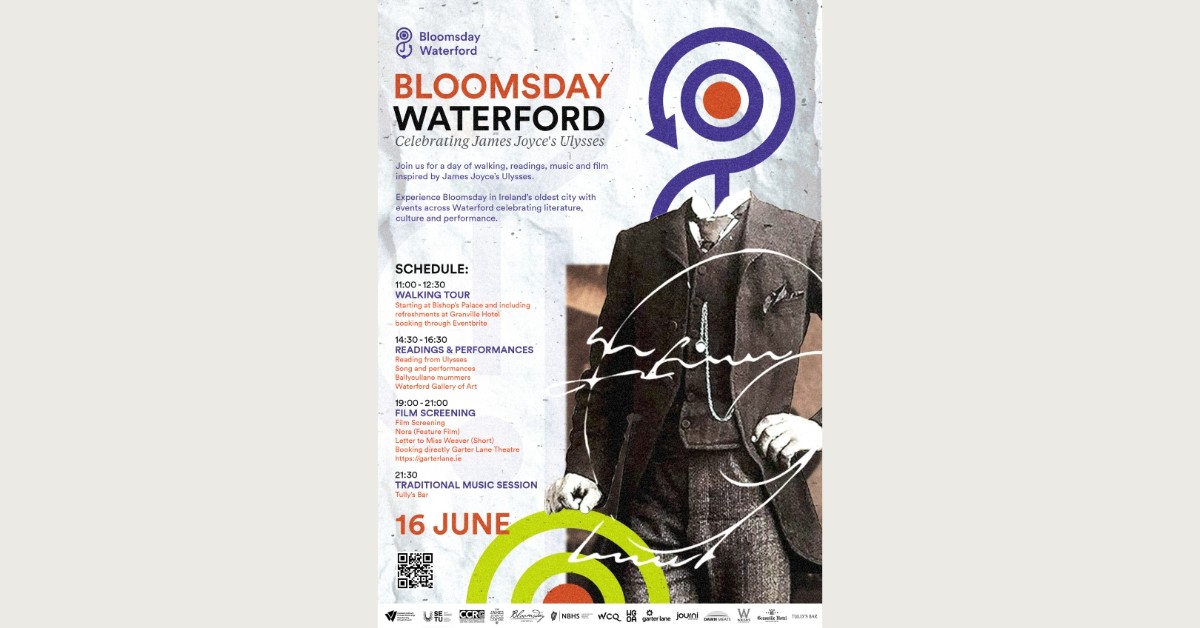
Waterford is getting its own Bloomsday festival. On Tuesday 16 June 2026, the city’s Cultural Quarter will host a full day of events celebrating the life of James Joyce and the world he conjured into being — with a programme that is emphatically not a Dublin import but a celebration rooted in the south-east’s own deep and largely unheralded relationship with Ireland’s greatest novel. Film screenings, a theatrical performance, traditional music, and one of the most unusual folk performance traditions in the country: this is Bloomsday in Waterford, and it is worth your entire day.
What Is Bloomsday?
Bloomsday takes its name from Leopold Bloom, the protagonist of James Joyce’s 1922 novel Ulysses. Joyce set his entire narrative on a single day — 16 June 1904 — and the date was not chosen arbitrarily. It was the day James Joyce first walked out with Nora Barnacle, the Galway-born woman who would become his lifelong partner, the mother of his children, and the most significant creative influence on his work. Joyce later wove Nora’s voice, her sensuality and her particular directness of mind into the figure of Molly Bloom — the most famous interior monologue in world literature ends, essentially, with Nora’s voice saying yes.
Bloomsday has been celebrated in Dublin since 1954, when a group of writers including Patrick Kavanagh and Flann O’Brien retraced Bloom’s route through the city. It is now observed on every continent — in Trieste, where Joyce lived for years; in cities across the United States; in Japan, where Ulysses has a devoted readership. Waterford joins that tradition this June for the first time, with a programme that brings something genuinely new to the celebration.
The Programme
Molly Bloom’s Soliloquy — Claire Mullen
The centrepiece of the day is a performance of Molly Bloom’s Soliloquy by actress Claire Mullen, who has Tramore connections. The soliloquy — the concluding episode of Ulysses — is one of the most demanding and celebrated pieces of theatrical text in the English language: forty-five pages of unpunctuated stream of consciousness, moving through Molly’s memories, desires, frustrations and affirmations as she lies in bed in the early hours of 17 June. It ends with the word “yes” — eight times, in the final lines, building to the most famous full stop in literature. To perform it well requires a particular combination of technical command and emotional transparency. Claire Mullen is a renowned actress; this will be the highlight of the festival.
Film Screenings — Garter Lane Arts Centre
Garter Lane Arts Centre will host two film screenings as part of the festival, both with direct connections to the south-east of Ireland.
The first is Nora (2000), directed by Pat Murphy, who has West Waterford connections. Nora tells the story of Nora Barnacle and her life with Joyce, with Ewan McGregor playing Joyce and Susan Lynch in the title role. Murphy made the film after reading Brenda Maddox’s biography of Barnacle, which identified something paradoxical about Nora’s place in literary history: her voice is everywhere in Joyce’s writing, yet she herself has been rendered invisible to most readers. The film is an act of restoration — an attempt to return Nora to the centre of a story that she helped to create. It won Murphy the United International Pictures Director’s Award and Irish Film and Television Awards. Seeing it in Waterford, introduced by the director herself, is an occasion.
The second film is Letter to Miss Weaver, written and directed by Ger Duffy from Tramore and John Foley from Ballinacourty — two south-east filmmakers working with Joycean material in their own right. The film takes as its subject Harriet Shaw Weaver, the feminist editor and literary advocate who became one of the most important figures in Joyce’s life and career. Weaver was the editor of The Egoist magazine, which published A Portrait of the Artist as a Young Man in serialised form when no publisher would touch it; she later set up a press specifically to publish it in book form, and supported Joyce financially through the years when Ulysses was being written. She is one of the great unsung figures of 20th-century literature, and the fact that the filmmakers making a work about her are from Tramore and Ballinacourty says something significant about the south-east’s intellectual relationship with Joyce’s world. Tickets for both screenings are €6.50.
The Ballycullane Mummers — Gallery of Art, O’Connell Street
One of the most distinctive elements of the Waterford Bloomsday programme is a performance by the Ballycullane Mummers from County Wexford, at the Gallery of Art on O’Connell Street. Mumming is one of the oldest surviving folk performance traditions in Ireland — a pre-Christian dramatic form involving costumed performers, stock characters and ritual narrative that persisted longest in Counties Wexford and Down. The Wexford mumming tradition is particularly strong and particularly unusual; Ballycullane is one of the most active surviving mummers’ groups in the country.
The juxtaposition of a medieval folk tradition and the most modernist novel in the English language is precisely the kind of curatorial instinct that makes Waterford’s Bloomsday feel different from a conventional literary festival. Joyce was deeply interested in folk tradition, in myth, in the layers of culture that lie beneath the surface of the everyday — these are mummers performing in the context of a day that celebrates exactly that kind of layering. It works.
A Talk With Pat Murphy
Ahead of or alongside the screening of Nora, the festival will include a talk with Pat Murphy about the film and the creative decisions that shaped it. Murphy is one of Ireland’s most significant directors — her earlier films Maeve (1981) and Anne Devlin (1984) are canonical works of Irish feminist cinema — and she studied film theory under feminist theorist Laura Mulvey at the Royal College of Art in London. A conversation with her about the challenge of making Nora Barnacle visible — of restoring a woman to the centre of a story that has always credited the man — is not to be missed.
The Croppy Boy — Tully’s Bar, Hosted by The Deise Boys
The evening ends where the best evenings in Waterford tend to end: in a pub, with music. The Deise Boys host a traditional music session at Tully’s Bar under the name The Croppy Boy — a reference to the Irish rebel ballad that appears in the Sirens episode of Ulysses, sung in the Ormond Hotel bar while Bloom sits nearby listening and thinking. The session is open to local musicians and singers, in the spirit of the communal, participatory music-making that runs through both the novel and the living tradition of Irish pub sessions. It is the right ending for a day like this.
Why Waterford? Why Now?
Bloomsday belongs to Dublin in the cultural imagination, but Ulysses belongs to everyone who has read it, and the south-east of Ireland has its own relationship with Joyce’s work that is deeper than most people outside the region realise. Two of the filmmakers in this festival’s programme are from the same corner of the county. The director of the most significant Joyce-adjacent film in Irish cinema has West Waterford connections. The actress performing Molly Bloom’s soliloquy has Tramore connections. This is not a borrowed celebration; it is a local one, discovering its own relationship to a text that has been speaking to this region for generations without a dedicated occasion to mark it.
The Bloomsday Voluntary Committee, with Mary Howlett among its founders, organised the festival with the support of Waterford City and County Council and Arts Officer Margaret Organ. The hope, one imagines, is that this is the first of many — that Waterford adds its own voice to the global chorus that says yes to Joyce every June 16th.
How to Attend
Bloomsday in Waterford takes place on Tuesday 16 June 2026 across the Cultural Quarter in Waterford City, with film screenings at Garter Lane Arts Centre (€6.50), the Ballycullane Mummers at the Gallery of Art, O’Connell Street, and the evening traditional session at Tully’s Bar. Booking information for the full programme is available on Eventbrite. Follow the festival on Instagram and Facebook for the full schedule and any additions to the programme.
She triumphed and laughed and kissed the earth for him with her mouth and cried Yes I will Yes.
James Joyce, Ulysses — Molly Bloom’s Soliloquy