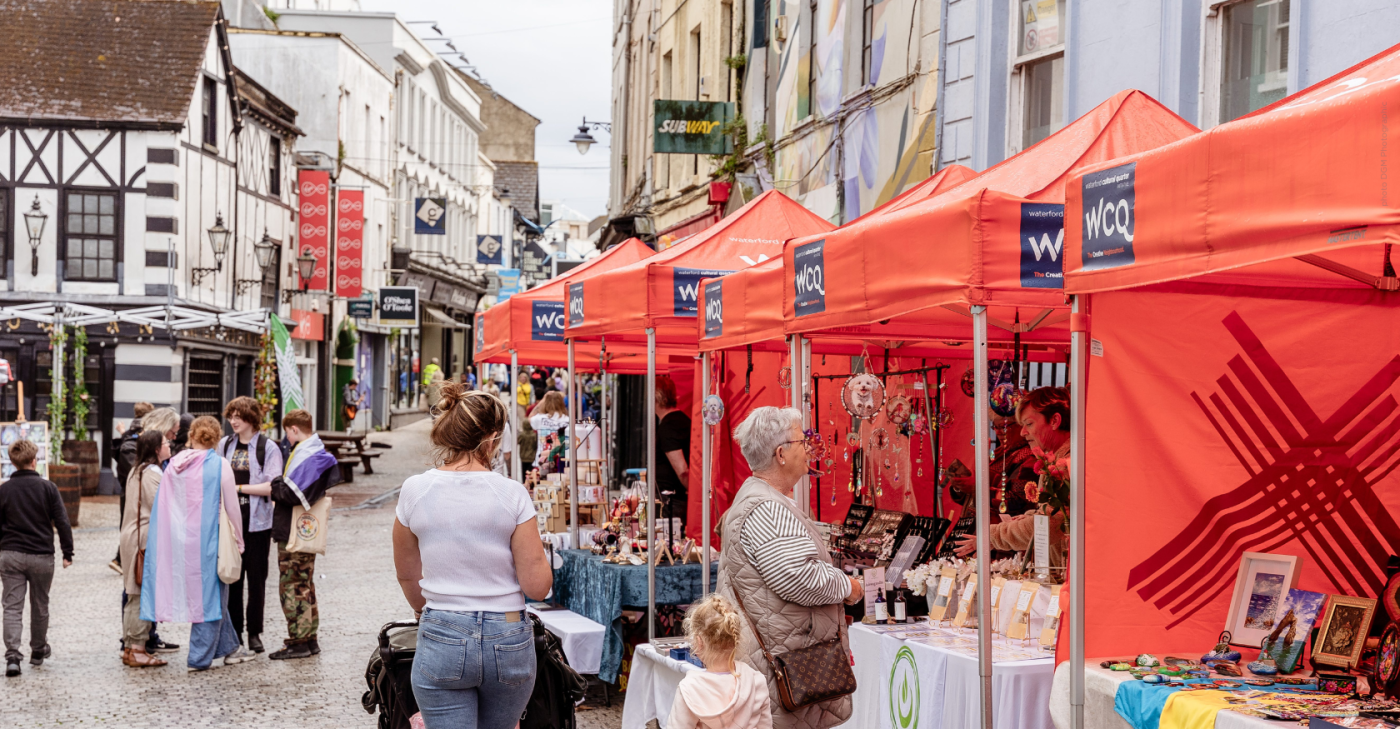
On any given Saturday between May and September, Great George’s Street in Waterford comes alive with makers, growers and crafters selling their work directly to the public. The WCQ Crafts Market is a weekend market dedicated to locally produced crafts and food — seasonal, community-rooted and genuinely independent. What most visitors don’t know is that the market itself, its physical design and the stalls within it, was shaped from the ground up through one of the most thoughtful examples of community co-design seen in an Irish city in recent years.
What Is the Waterford Cultural Quarter?
The Waterford Cultural Quarter (WCQ) is an urban regeneration initiative centred on the O’Connell Street area of Waterford City, stretching from Great George’s Street to the Waterford Distillery on Mary Street. Its vision is ambitious: “to deliver inclusive and sustainable innovation and growth for the cultural and creative sectors of south east Ireland; to become a distinctive and engaging place at the heart of Waterford which is open, inspiring and a vital addition to the city’s creative, knowledge and visitor economy.”
That vision has significant public backing behind it. In 2021, Waterford City and County Council was awarded €27 million from the Irish Government’s Urban Regeneration and Development Fund (URDF) for city centre regeneration, with a specific focus on the Cultural Quarter area. The funding is financing a range of projects: the WCQ Place Community and Cultural Hub, the Scéal Smart City development, Thomas Street Art Houses, a city pocket park, and the Beach Tower Square Cluster — the refurbishment of two four-storey Georgian buildings on Great George’s Street that will connect the Cultural Quarter to the city’s main retail area. The crafts market sits within this larger regenerative ambition as one of the most immediately visible and publicly accessible expressions of it.
The Market, Today
The WCQ Crafts Market runs on Great George’s Street from May to September, every Saturday from 10am to 4pm, with occasional Sunday openings through the summer. In winter, the market relocates to Hanover Street for a seasonal iteration running Saturdays and Sundays from 11am to 6pm between late November and late December — timed to coincide with Waterford’s Winterval festival, which draws approximately 600,000 visitors to the city over the Christmas period.
The market’s central purpose is straightforward: to give Waterford’s crafters, makers and food producers a dedicated, well-designed space to sell directly to their community and to visitors. In a city centre where independent retail has faced the same pressures as everywhere else in Ireland, a market that operates on a pedestrianised street in the heart of the Cultural Quarter offers something that cannot be replicated online or in a shopping centre — the direct encounter between maker and buyer, the conversation that happens over a market stall, the sense of a city’s creative community made visible.
The Co-Design Process
What makes the WCQ Crafts Market particularly interesting is not just the market itself but the process by which it came to exist in the form it does. Rather than commissioning a design and presenting it to the community, the project’s partners took a different approach: they asked the community to help design it.
The co-design project was led by Connect the Dots, a community engagement consultancy, working alongside architect and designer Rae Moore of Atelier Rae Studio. The process was developed under the Irish Architecture Foundation’s Reimagine Programme in partnership with Waterford City and County Council, the Waterford Cultural Quarter, SETU’s School of Architecture (then WIT), and Waterford Area Partnership.
The engagement ran across seven phases: communications, online workshops, in-person workshops, shared insight sessions, focus groups, information gathering, and a final report and findings. A community survey generated over 70 responses. Individual meetings were held with local stakeholders — market traders, residents, business owners and creative practitioners — to ensure the design process was informed by the people who would actually use and inhabit the space. As the project team put it, the aim was to “bring vibrancy into an area of the city with a number of vacant heritage buildings, provide economic opportunities, and celebrate the Waterford Cultural Quarter’s rich multicultural identity.”
The Architecture Students
One of the most distinctive elements of the co-design process was the involvement of 28 fourth-year architecture students from WIT’s School of Architecture — working in four groups, under tutors Dr Sharon O’Brien, Richard Kenny and Maire Henry — who were tasked with developing market stall prototypes in late 2021 based on the community research gathered in the earlier phases of the project.
The students produced four separate design proposals for the market stalls, each responding to the community’s stated needs: flexibility for different kinds of traders, adaptability to weather, visual coherence that respects the character of Great George’s Street, and practicality for the makers setting up and packing down each weekend. A tent was hosted at Waterford’s Winterval festival specifically to gather public feedback on the student designs — bringing the design process itself into the public sphere and closing the loop between community input and architectural response.
It is a genuinely unusual model for a public design process — and a valuable one. Architecture students are rarely asked to solve real problems for real communities in real time; the feedback loop between proposal and community response is almost always simulated rather than live. Here it was real, and the students’ work fed directly into the Market Design Guide that forms one of the project’s key deliverables.
The Design Guide
The co-design process concluded with the production of a Market Design Guide — a document providing architectural drawings, practical guidance and a roadmap for the market’s establishment and ongoing development. Supplementary funding enabled the engagement process to be more tailored than originally planned, and the project team identified the Design Guide as essential for the market’s long-term success: a reference document that captures the community’s vision and translates it into actionable design guidance that future decisions can be measured against.
It is worth noting the timeline the project navigated. Storm Barra and the Covid surge of late 2021 disrupted the original schedule, delaying planned co-design workshops. The project team adapted and continued, eventually completing the process with a community workshop in March 2022 to finalise the shared vision. The market that now runs on Great George’s Street every summer Saturday is the physical result of that sustained effort.
Why This Model Matters
Co-design is a term that gets used loosely in planning and regeneration contexts, sometimes as a synonym for a public consultation meeting where the plans are largely already made. What happened with the WCQ Crafts Market was something more genuine: a multi-stage process in which community input — from 70-plus survey responses, from stakeholder meetings, from the public reaction to student design proposals at a winter festival — actually shaped the output. The market stall designs, the market’s operating model, its location and seasonal rhythm, all emerged from that process rather than preceding it.
That matters because it produces something that a commissioned design rarely achieves: a market that the community feels ownership of, because it was asked and genuinely listened to. The crafters who set up on Great George’s Street each Saturday are not occupying a space designed for them by a consultant working in isolation; they are occupying a space designed with them, responsive to their needs and the needs of the community around them.
Get Involved
The WCQ Crafts Market is open to makers, crafters and food producers based in Waterford and the surrounding region. If you’d like to trade at the market or get involved with the Waterford Cultural Quarter’s broader programme of activity, contact the team at culturalquarter@waterfordcouncil.ie or call 0761 10 2643. Follow @waterfordculturalquarter on Facebook and Instagram for market dates, trader announcements and Cultural Quarter news.
To bring vibrancy into an area of the city with a number of vacant heritage buildings, provide economic opportunities, and celebrate the Waterford Cultural Quarter’s rich multicultural identity.
WCQ Crafts Market Co-Design Project Brief